
Teaching
Pratt and School of Visual Arts

I taught at the School of Visual Arts for more than twenty years and at Pratt Institute for almost fifteen, and I loved every minute of it. Here are just a few of the students I had over the years:
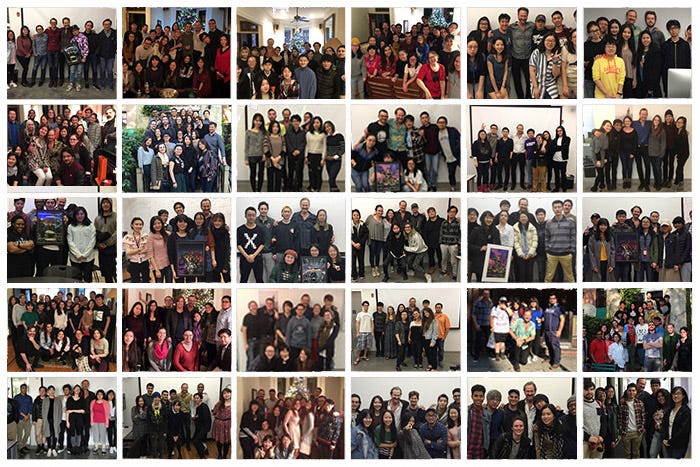
Being an artist is a solitary business. You spend long hours working alone, solving problems in silence, chasing ideas that don’t reveal themselves easily. That solitude has its value, but it can also become a closed circuit since you don’t get the chance to test your thinking with other artists.
Teaching changed that completely. In the classroom, I was surrounded by energy, questions, resistance, and curiosity. Young artists at the beginning of their careers don’t know what they don’t know, and that can be tremendously freeing. They look at problems without the force of habit, and often see things you’ve stopped noticing. I went in expecting to teach, but I quickly learned that I was also there to listen. One of the surprising truths of teaching was I how much I learned from it. I began by trying to pass on what I knew, but I ended up constantly re-evaluating it. Students don’t just absorb ideas, they challenge them, reshape them, sometimes discard them, and in doing so, they forced me to reconsider my own assumptions. I learned as much from my students as I ever taught them, sometimes more.
My path into teaching at the School of Visual Arts (SVA, as everyone calls it) was accidental. They needed a matte painting instructor, as the previous one hadn’t worked out. At the time, I may have been the only union matte artist living in New York, so they gave me a call. SVA was unusual in that they were not concerned with academic credentials. They cared about what you had actually done in the world. Your credits, your experience, and the work you had produced was what mattered. Other institutions I taught at were different in that the emphasis was on formal academic achievement, like master’s degrees, or a PhD. I never fully understood the assumption that those qualifications automatically translated into being a good art teacher. I felt the opposite was true, that some people used academic study as a way to delay entering the uncertainty of real creative work. I never earned a master’s degree or a PhD, and in some academic settings I had to receive special dispensation just to teach. At the time, it struck me as an odd hurdle. Not because education isn’t valuable, but because in art the work itself is the education. Most of the people I knew who held doctorates in art had them in art history, which is its own important discipline, but quite different from the lived experience of making images and solving visual problems.
While teaching at SVA, I took advantage of a program that allowed instructors to take as many classes as they taught for free. I was surprised to discover how few other teachers made use of it. Not only did I get the chance to learn something new, but I was also able to observe other teachers in action. I’ll admit that there were times I found myself being critical. That’s probably inevitable when you are a teacher yourself. But I kept my mouth shut and paid attention. There’s always something to learn, sometimes what to do, sometimes what not to do. One “master” teacher I studied with was Eric Reinfeld. I not only learned a lot about the subject he was teaching, but also how to be a good teacher. He has a reputation at SVA for being tough, and that reputation is well earned, but so is the respect that comes with it. As a fellow teacher, I admired how he pushed students to work hard without ever becoming a tyrant. He maintained order in the classroom, something I’ve always believed is essential. Too many instructors seem more interested in being buddies with their students, but that’s not why students are there. Eric is a warm, generous person, but he expects you to perform. If you’re a student at SVA today, do yourself a favor and seek him out.
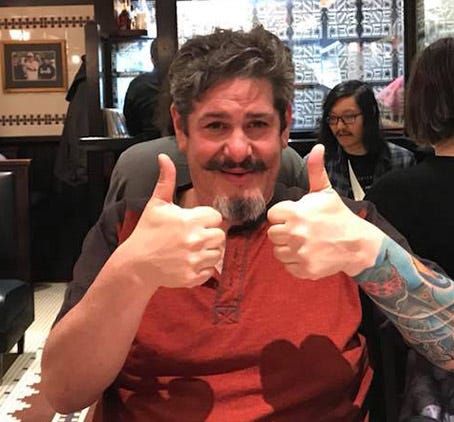
Eric Reinfeld
Grade inflation has become a problem in many of the schools. Back in my day, a “C” meant you did acceptable work where you showed up, did what was required, and you got by. Getting a “B” meant you did something better than that. An “A” was reserved for something exceptional, and you had to earn it. Today, many students seem to start from a different assumption: that an “A” is the default, and anything less requires an explanation. I had a situation that really brought this home to me. In my classes, I make my expectations very clear from day one: if you miss three classes, you fail. One student missed six out of fifteen classes. On top of that, they didn’t turn in a single assignment all semester, so I failed them. I didn’t think much of it as it seemed self-explanatory.
Then I got called into the department head’s office. The student was there with the parents and they wanted the grade changed. I explained the situation: the absences, the missing work, the policy that had been clearly stated from the beginning. The parents argued that I was being too hard, that the grade should be raised anyway. At that point, the department head stepped in and said the grade would stand, and the meeting ended with the parents furious at me. Mercifully, most of my students weren’t like that. Most of them worked incredibly hard, and I like to think they got a lot out of my classes.
After five years at SVA, I realized how much I loved teaching and started looking for more classes. I interviewed with Peter Patchen, the Pratt computer arts department head, and he hired me. Pratt had stricter academic requirements for faculty, and since I didn’t have a master’s degree, I needed a special dispensation to teach there. Apparently, my professional work was good enough that I passed muster. While I was there, I introduced a compositing class using Nuke by a company called The Foundry (https://www.foundry.com/products/nuke-family/nuke). It is the industry-standard software for compositing, but it hadn’t yet been included in the curriculum. Building that class from scratch was one of the most satisfying things I did as a teacher.
I came to see that the classroom was its own kind of studio, not a place separate from my art making, but another form of it. I arrived thinking I was there to instruct, but what I was really doing was participating in a shared process of discovery. I had to retire from teaching due to some physical problems I’ll talk about in the future. Over the years I taught thousands of students, and teaching was one of the great joys of my life. I miss it.
Thanks for sharing David!
As you know I came from a family of teachers both academic and industrial. My appreciation of teaching like yours is also based on the opportunity to learn. See my reflection on my 50 years of teaching: Substack.com/@PERSONALconcerns
https://substack.com/home/post/p-190932455