
What is “morphing?”
A cross dissolve with warping

A lot of people ask what morphing is exactly. At its most basic, it is a cross dissolve with warping.

In old movies, like Lon Chaney’s Wolfman, there would be a cross dissolve between Lon and him made up as the Wolfman. Chaney had to stay in exactly the same position while the makeup was applied, since if he moved, there would be a double exposure from the previous position. This didn’t allow for the position of any features to move, since if anything moved, that would yield a double exposure also.
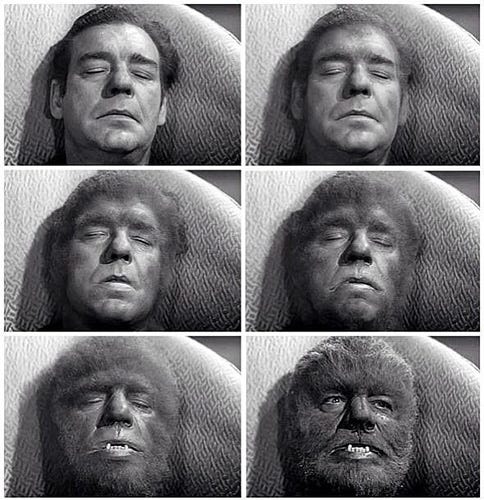
Wolfman cross dissolve
Morphing got around that problem by warping to features into a new position before the cross dissolve happened. The artist would set up a series of splines for each feature, defining the start and end poses, then warp the initial image, and dissolve it into the target image to create a smooth transition.
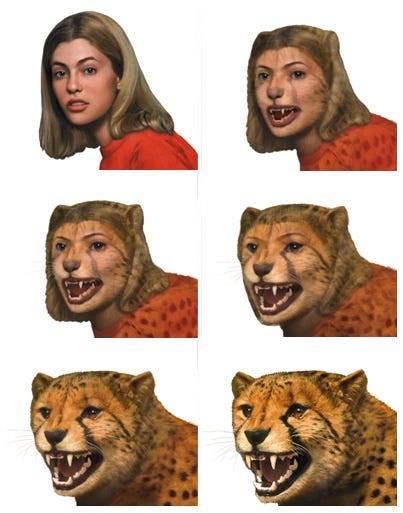
Full morph between Rachael and cheetah
The first morphing I ever saw was in Willow, directed by Ron Howard. Dennis Muren was one of the visual effects supervisors, and I think he was instrumental in developing morphing. It allowed the audience to see the full transition, rather than cutting away. Considering that this was just at the start of the digital age, and many of the shots were put together on an optical printer, the work in Willow still looks remarkably good!
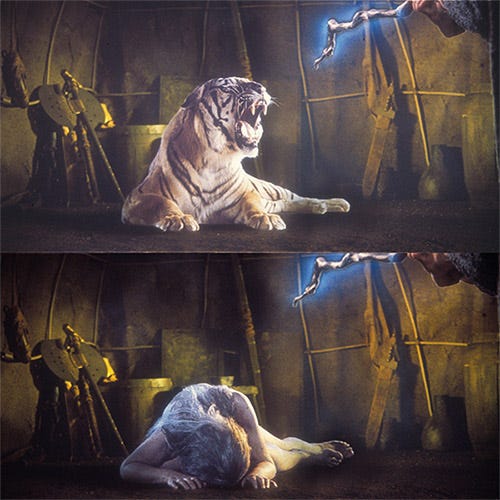
Willow
The next time I saw morphing was in the second Terminator movie, T2. I remember seeing in disbelief Robert Patrick’s metal Terminator walk out of the flames—my mind was blown. Even with my extensive knowledge of visual effects, I could not figure out how it was done.
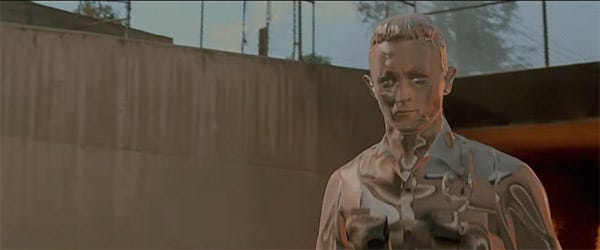
T2
Now morphing has been done so many times that it doesn’t look so unusual. Visual effects artists always try to come up with WTF moments that no one can figure out, but morphing and The Matrix’s bullet time are some of the few examples I can think of. Morphing has been done a lot now, from Indiana Jones and the Last Crusade to The Golden Child, to Star Trek: Deep Space Nine, Independence Day, The Mask, and Michael Jackson’s music video for Black or White.
Whenever an artist comes up with something fresh, it’s then done over and over by others, and is no longer new. It is that way in all the arts. Imitation truly is the sincerest form of flattery.
I used Elastic Reality to do all of my morphs for the Animorphs covers, and it was a frustratingly unstable program. It no longer exists as a stand alone, and was rolled in to Softimage.
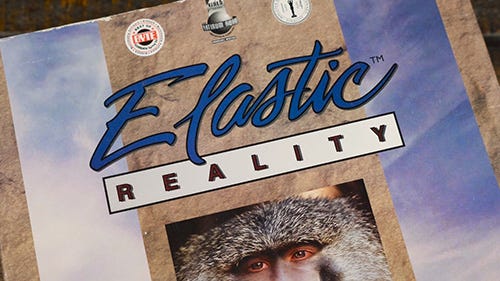
At the time, it was the only commercial program that could do morphing, but now it can be done in After Effects and a compositing program called Nuke. I use Nuke for morphing currently.
Here is an excellent tutorial on how morphing was done using Elastic Reality:
Since I did The Animorphs digitally, there is no original artwork. However, you can buy signed prints of any of my covers on Etsy here:
https://www.etsy.com/shop/AnimorphsArtStore?ref=seller-platform-mcnav
I have a very few Animorphs oriented items still up on eBay. This is everything I have left:
https://www.ebay.com/itm/236285661088
https://www.ebay.com/itm/335948712633
https://www.ebay.com/itm/236088763517
I've actually tried to make those myself with Squirlz morph and/or Facemorph, I found someone on Deviantart who actually makes their own versions.
https://www.deviantart.com/aizxana/art/Full-Body-Morph-Tutorial-P1-67650141