
In Defense of Repeating Yourself
You never know when something great will happen

Many artists have an absolute horror of repeating themselves. There are plenty of great artists—like Picasso, Monet, and Pollock—who produced breakthrough work that was far ahead of popular taste, and they took their share of crap for it. Picasso, in particular, did genuinely groundbreaking work early in his career. But in the last fifty years of his life, he often revisited and reworked ideas he had already explored when he was younger. I don’t actually have a problem with that.
Two artists who profoundly influenced my own work are Jim Steranko and John Buscema. Steranko had a deep aversion to repeating himself. Each project he took on had something new about it, and once he felt he had outgrown an artistic arena, he moved on to another. The result is a relatively small body of work. He wasn’t interested in grinding out variations on a theme. Buscema, on the other hand, took almost the opposite approach. He wasn’t concerned with innovation so much as craftsmanship. He kept producing pages steadily until the end of his life, building an enormous body of work. It wasn’t that Buscema’s work didn’t change over time, it did. But he never said “I’ve done that, I have to do something new.” His work got better and more fluid as he got older, but that is because he kept plugging away at it. Of the two, Buscema is closer to my own temperament. I never worried much about whether what I was doing was groundbreaking. I just tried to do the best job I could with what I was given. When an artist isn’t closely monitoring themselves, they tend to repeat what has worked before. Much of this is unconscious. I certainly repeated myself in my own work.
One example is the left-to-right diagonal that appears in many of my covers.
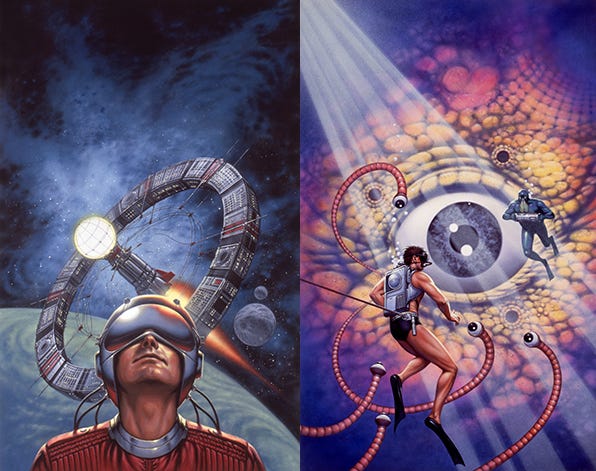
Part of that came from the constraints of paperback design, with the diagonal helping to unify the two halves of a wraparound composition.
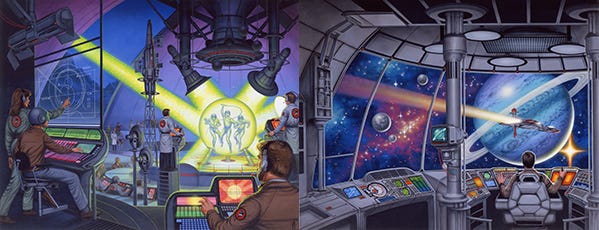
I also gravitated toward certain colors, Phthalocyanine Blue and Quinacridone Magenta, because they are particularly strong in acrylic. Every medium has its standout colors, and those two have a power that’s hard to resist. I’ve noticed that Michael Whelan, who also works in acrylic, uses them frequently as well. When you look at my work, those colors are part of my visual signature, for better of worse.
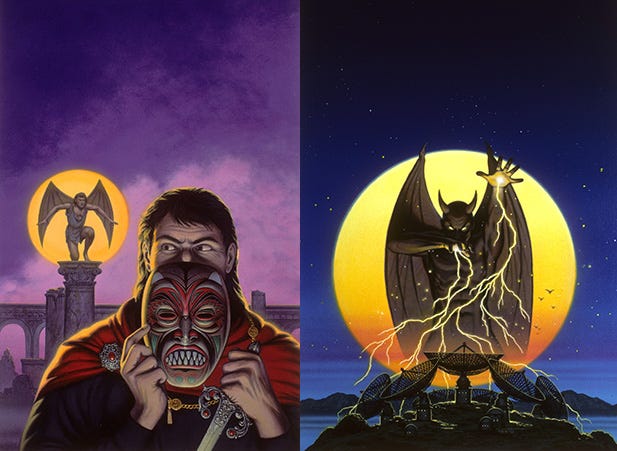
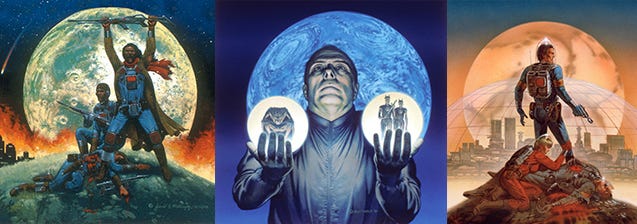
Another recurring motif is the use of a large moon (the two above are also good examples). Eventually I became aware that I was relying on it too often and made a conscious effort to stay away from it in later work.
That isn’t to say there aren’t artists I wish hadn’t repeated themselves. I think James Cameron, one of the best directors who ever to lived, would have been better off stopping at Avatar 1, and never doing 2 and 3. I think Francis Coppola’s reputation would be even greater without Godfather 3. Thank goodness David Lean never did a sequel. Can you imagine Lawrence of Arabia 2?
It’s difficult to force innovation—especially if you approach each new piece thinking, “this one has to be different.” I found it more productive to simply do the work. Every now and then, something unexpected happens, and that’s where the real innovation comes from.
You can buy signed prints of any of my paintings, even the ones where I repeated myself, here:
www.davidmattingly.com
This is really interesting self-awareness about themes and "crutches" that we rely on as creative professionals!