
Pixels or Paint
The best and worst things about being a digital artist

In September of 1993 I borrowed $10,000 from my brother John and bought my first computer. In the intervening years I have had a lot of time to think about the plus and minuses of working digitally, and I am going to tell you the three best and worst things I know about being a digital artist.
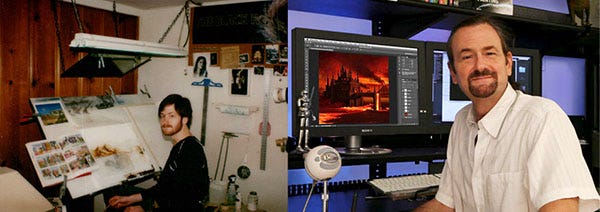
The best thing about working digitally is:
The undo button.
No matter how talented an artist you are, it is difficult to make radical changes in a painting when you work traditionally. If you are halfway through a piece, look at it and think “what if I shifted the entire background more toward blue?”, you probably won’t do it, since it is such a pain. However, working digitally, you can make the most radical experiments with a composition at any point in the creative process with no fear that you will totally screw it up. When I was painting in acrylics, I can’t tell you how many times I would rework a face, only to think “crap, it looked better BEFORE I did that….” In a digital painting, you just make a new layer, try out your experiment, and it works, keep it. If it doesn’t, you get right back to where you were with no loss. It encourages experimentation, trying new things, at any point in the compositional process. It has made me a less timid painter.
The worst thing about working digitally is:
The undo button.
There is a lot to be said for planning ahead while you are doing a painting. Working traditionally forces an artist to make decisions about a composition and stick with them. Part of why working digitally has not speeded up my production substantially is because I am constantly trying new things as I go along. When you work with paint, every step of the composition is for keeps unless you are willing to wipe out what you have done and completely re-do it. Working digitally has also allowed me to not make those decisions as I go along, since any problem area can always be fixed “later”, and that isn’t always a good thing.
The second-best thing about working digitally is:
No original.
If you are an illustrator, almost no one will ever see your original, while thousands of people will see the printed piece. Worrying about the original is so last century! You should only worry about what the printed piece will look like—as an illustrator, that is your real obligation. Thinking about how exquisite your transparent underpainting looks, or how great that impasto light passage is has nothing to do with how it will be seen by most of your audience. All of that is lost when it is printed.
The second worst thing about working digitally is:
No original.
Having said that, is there anything better than going to a museum and seeing the original of a painting you have admired, only to find that the original is about 100 times better than any reproduction could ever be? I was never a big fan of Velazquez’s work until my wife Cathleen and I went to Spain and saw a bunch of his original paintings. What a painter! You can’t believe how great his transparent underpainting looks, and his passages of impasto lights make me feel like I’d seen God. He didn’t work for reproduction, so all that is lost. You must see the original to appreciate his greatness.
When I was working traditionally, I always loved to be able to hold the original in my hands after I was done. The “thingness” of a painting is a wonderful quality, and there is no “thingness” of a digital piece of artwork. You can make prints of the digital art, sign and number them, print them on canvas, have other people or yourself paint on top of the print ala Tom Kinkade, but when you work digitially you don’t get an original that you can hold in your hands and carry about and sell. A print is a print, and no one ever prefers a print of a piece to the original painting. I went to art school with Tom Kinkaide, and knew him a little, so I have been amazed by his success at selling expensive glorified prints to people. Prints are prints, and it is silly to pay a lot of money for a print. Seriously, if you are paying more than 100 bucks for a print, you are being taken.
The third best thing about working digitally is:
Using your reference directly.
When you work digitally, if you have a perfect piece of reference, like a great sky, you can just drop it directly into your composition and avoid the tedium of repainting it. In any composition, there are always a lot of things you have to paint, but why waste your time recreating something that is already perfect in your reference file? Being able to directly mix your photo reference with painting is a great way to work.
The third worst thing about working digitally is:
Using your reference directly.
How many digital compositions have we all seen that are just a bunch of photographs sandwiched together to make a picture, perhaps with a few passes of Photoshop filters over the elements to make them look more “painterly.” One great thing about doing your paintings in paint is that it forces you to put your mark on every element of the composition. Even if you have a great piece of reference, it still has to pass thought your hand and brain to get to the canvas. One of my favorite artists, Bruce Jensen, gave me a piece of advice that has changed how I think about putting together a picture: don’t worry about the resolution of reference elements in your composition. When I started working on the computer, I have always tried to get the best, highest resolution imagery for every element in my painting. What Bruce suggests is to just drop whatever reference you have into a composition and then paint over it. If you reference is too pristine, and high resolution, you won’t want to paint over it, since it already looks so good. But is you have dropped in reference from any number of sources, not worrying if the detail was adequate, it will free you up to paint over it and make it fully part of your composition.
Some parting words:
A few words of advice for anyone struggling to decide whether to make the jump to the computer. Are you an artist who takes advantage of what paint can do? When you look at some of the classic painters in the field, like Boris, Frazetta, and Donato, their work is all about what paint can do. They glory in what happens when paint blends on the canvas. The decision for me was easy, since my work was never about virtuoso passages of painting, but rather about detail and trying to make the piece look as realistic as possible. If you are an artist that loves the feel of paint on canvas, and your work communicates that, don’t buy a computer. There will aways be a place for the artist that loves the touch of paint on canvas. If you have a passion for what paint can do, owning a computer will only make your work worse. If you want to work analogue, with paint, do like my friend Jim Gurney and throw away your TV. Get rid of your computer. Trash your cell phone. Just concentrate on painting without modern distractions.
I, on the other hand, have loved being part of the digital revolution. I had the same feeling as the artists who lived through the advent of photography. When photography was invented, it freed artists from the task of just representing things, since you could get a photo of your loved one, or your favorite horse, or whatever, rather than having to hire an artist. It led to a lot of great art, like the impressionists, and the abstract expressionists. I think the digital revolution will do the same, since removed a lot of the mundane tasks from the illustrator. It eliminated a lot of markets along the way, but also created new markets for artists, like concept artists, digital compositors, matte painters, and computer animators. It’s an exciting time to be an artist, whether digital or traditional.
You can buy signed prints of all of my work through my web site at:
www.davidmattingly.com
Fascinating post David - thank you! Interestingly, the concept of "thingness" you mention in relation to an original piece of art is something we often discuss in archival circles, with original records having an "aura" about them that simply cannot be replicated by digitization. This is why many archivists, while of course recognizing the value of digitization for the purposes of access, still encourage researchers to engage with the originals as much as possible.