
Seventy: Not the Ending I Imagined
Getting old

I turned 70 today. In my 70 years on the planet, I’ve learned one thing:
Getting old sucks.
I had to retire, not by choice, from teaching at the School of Visual Arts and Pratt Institute. I loved teaching and letting that go was hard. Worse than that, I had to give up painting because of a condition called ataxia. Before I was diagnosed, I had never even heard the word. About ten years ago I started noticing problems with my balance, so I went to a neurologist. At first nobody knew what caused it. Eventually I got a diagnosis: ataxia.
https://www.ataxia.org
That sounds more definitive than it actually is since ataxia comes in a lot of different flavors, and even after every test available, no one could tell me exactly what kind I have. I’ve been given the label “idiopathic ataxia,” which is a medical way of saying they don’t know.
What I do know is what it’s taken from me. It’s affected everything below my neck—my hands, my balance, my voice. Painting became something I had to concentrate on, then harder, then difficult, and finally something I simply couldn’t do. My hands shake so much now that even my handwriting is barely legible. I miss painting. Ever since I was a kid, I thought of myself as an artist. I didn’t realize how much of my identity was tied up in that until it was gone.
Ataxia has another terrible feature—it messes with my emotional control. I cry inappropriately, and the tiniest thing can set me off. When I am happy, I cry. When I am sad, I cry. I don’t want to give the impression I cry all the time—I don’t. As long as things are not emotional, I am fine, but them moment something is the least bit tinged with emotion, I am off to the races. It is embarrassing, but I can’t control it like a normal person.
And just to round things out, my wife Cathleen has Parkinson’s and has lost a lot of her short-term memory due to Alzheimer’s. So in addition to dealing with my own limitations, I’m also her caretaker. Before this, I didn’t really understand what memory loss meant. I thought it was mostly about repeating yourself. It’s much more complicated than that. She has hallucinations and is constantly losing things. I’m the only one she trusts to find them, which means I spend a good part of my day doing exactly that. It is exhausting and heartbreaking. We have a wonderful companion who comes three days a week to take the pressure off me, but it is hard watching someone you love fade away.
One thing I’ve realized is how misleading our picture of old age is. Look at commercials and you’ll see vibrant, happy older people hiking, traveling, laughing. What you don’t see are people dealing with failing bodies, neurological conditions, or taking care of a partner who is slipping away piece by piece. That’s the part nobody advertises.
Looking back, I can trace some of my physical problems to something I didn’t even know I had for most of my life, a curvature in my spine.
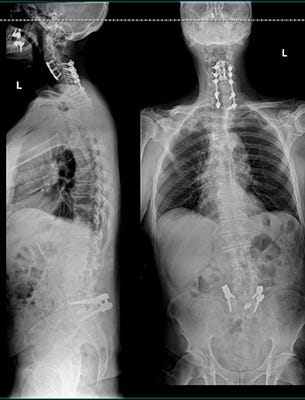
I only became aware of it in my mid-50s. It likely contributed to my severely flat left foot, which eventually had to be surgically fused after years of pain and difficulty walking.
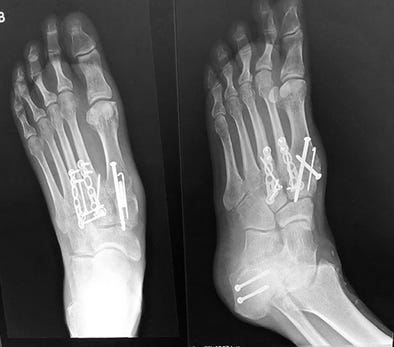
That surgery was a wake-up call. Being unable to put weight on your leg for three months teaches you very quickly how much of your independence depends on something as basic as walking.
I had imagined old age differently. I thought I’d still be painting and traveling the world with Cathleen, setting up somewhere beautiful and working the way I always have. One of my heroes, Chesley Bonestell, kept painting until he died. Maybe his work wasn’t as good as it was in his prime, but he was still doing it.
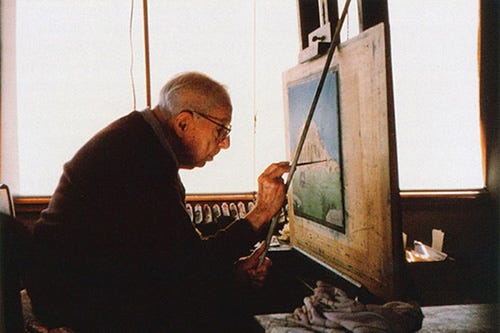
I thought that would be me. It wasn’t. And yet, I can’t say I’ve been cheated. This came late in my life, after I’d already had a long, fulfilling career. I got to do the work I loved for decades, I got to teach, I got to build a life, and I had a very happy 34 year marriage. So I don’t have much to complain about.
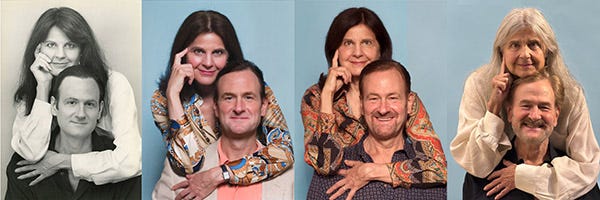
Although, of course, I will.
I just wanted to say how deeply your post resonated. You captured a side of aging that most people never see the part that takes things you never imagined losing. The honesty in your writing is a kind of courage, especially when you talk about ataxia, the loss of painting and the emotional swings that come with neurological conditions. Sharing all of that is not easy.
I’m not writing to offer clichés. You’ve lived a full creative life, and you’ve earned the right to say that losing painting hurts. When your hands stop doing what your mind still knows how to do, it isn’t just a skill that disappears. It’s a piece of identity. You spent decades building that identity, so of course it matters.
I also wanted to share something you may not have been told clearly. There are artists with tremors, ataxia, Parkinson’s, ALS, and other motor conditions who still create. Not in the same way as before, but in ways that let their artistic mind stay in charge. Some use weighted gloves or arm supports to steady their hands. Others switch to larger canvases and broader tools that don’t require fine precision. There are painters who use sponges, rollers, or palette knives because expression becomes more important than detail.
And beyond physical tools, digital art has opened doors for people with limited motor control. Some paint using eye‑tracking systems. Others use head‑tracking devices that let them guide a stylus with small movements. There are programs that let you paint by speaking commands. Artists who can barely move their hands still create meaningful work this way.
There’s also something quietly beautiful happening in the art world. Some artists train digital tools on their own past paintings so they can continue producing new work in their personal style, even when their hands can’t make the strokes anymore. It isn’t a machine replacing the artist. It’s the artist finding a new way to speak.
None of this erases the loss or pretends your body hasn’t changed. But it does mean your artistic voice can keep going, even if the method looks different now.
None of this is meant to argue with what you said. You’re right: the process matters. It’s the heart of it. And losing that hurts in a way only another artist can understand. I just wanted to say that there are ways to keep creating that don’t erase the meaning of the work or the experience behind it. They don’t give back what was lost but they can give back a little of what painting felt like the sense of shaping something, guiding it, watching it come alive.
You spent your life teaching others how to see. You painted worlds that didn’t exist until you made them real. That part of you is still here. It hasn’t gone anywhere. It’s waiting for whatever new tools your hands or eyes or voice can use.
You’re still an artist. The medium just needs to adapt to the man you are now.
You're right, David. It's a reality that people share as a category but few actually share personally because each experience is individual.
So this is acknowledgement, more than comfort: what you're doing here is very worthwhile. It's a side I have often wondered about but hadn't seen. Your perspective is rare; can't be improved on; can't be replaced if we lose it.
It's not self-indulgence, or merely self-soothing. It's part of the cultural conversation that *is* the legacy of art.
Many artists don't write about it. I'm glad that you do.