
Artist’s Agents
"Velvet Talks" magazine

Early on in my career, I did two assignments for a men’s magazine.

Here’s how it happened. When I was just starting out in illustration in Los Angeles, I signed up with an agent, Jae Wagner. She represented several artists I admired, and I had visions of her getting me high-paying, glamorous assignments. To her credit, she did get me work. To her discredit, at least from my point of view, it wasn’t always the kind of work I wanted. At the time, agents typically took 25%, but the idea was they’d make up for it by keeping you busy and landing better-paying jobs. My contract had one important carve-out: any work I got out of New York wasn’t subject to her commission. I didn’t want to pay her for work I was already getting.
What I didn’t understand was that once you have an agent, you’re expected to say “yes” to pretty much everything. Jae started getting me pretty good paying assignments from a magazine called Velvet Talks.
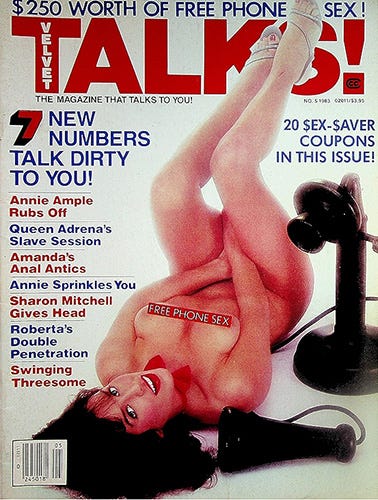
If you’re not familiar with it, the selling point was that each issue was that it included a record of one of the “models” talking dirty.

This was the dawn of the Penthouse era, and Playboy’s relatively tame sensibility had already gone out the window. Velvet Talks pushed things even further. The photographs were well past my personal comfort zone. I didn’t want to do the jobs, but Jae thought I was being ridiculous. “It’s good paying work,” was the argument. “Don’t be so picky.” She had a point, so I said yes. Professionally, the illustrations turned out fine, but personally, I didn’t want anyone to know I did them. I decided to put my foot down and not accept that sort of assignment. This did not improve my relationship with Jae. Having complained about the Velvet Talks jobs, I had crossed over into “difficult artist” territory. From her perspective, she was bringing me work and I was turning it down. From my perspective, I was trying to have some control over what I put my name on.
Things got tense enough that we eventually agreed to part ways, and that’s where the real difficulty started. I had signed a three-year contract stating that she would receive 25% of any work I did in Los Angeles, but I had excluded my New York work. I came up with a simple solution: I stopped working in Los Angeles. I lived in Los Angeles, but if I took work there, I owed her 25%. So I shifted everything to New York. What that did was strengthen my relationships with my New York clients. I started traveling there regularly to show my portfolio, and somewhere along the way I realized something surprising—I loved New York. I loved walking everywhere. I loved the density, the energy, the sense that everything was happening all at once. After years in Los Angeles, where you have to drive everywhere, which I’ve never enjoyed, it felt like a completely different life. When Del Rey Books offered me a two-year contract to help cushion the move, I didn’t hesitate. I packed up and moved and spent my first year in a Tribeca apartment just off Canal Street. Then my first wife, Barbara, and I started looking to buy a place. Somehow we ended up in Hoboken, which at the time was full of artists because you could actually afford studio space there.
The place we bought was not in great shape. There was a hole in the ceiling where you could see the sky, but it was ours. Hoboken has since become much swankier, and most of the artists have been priced out. I, however, got in early and never left. I’ve been here for 40 years now. Barbara and I divorced about a year after buying the place, but she made it possible for me to keep it—something I’ve always been grateful to her for. A year later I met my second wife, Cathleen, and five years after that we were married. So, in a roundabout way, refusing to keep doing questionable magazine illustrations, and blowing up my relationship with my agent, led directly to my living in the New York area and meeting Cathe.
For the record, I’m not anti-agent. Plenty of artists thrive with them, especially if they don’t enjoy dealing with clients. I was different in that I liked talking in person to art directors, and seeing their reactions to my work firsthand. Also, practically speaking, if you’re not paying someone 25% of your fee, you can price your work more competitively.
Great piece, and highlights the ways in which the paths of our lives can take fascinating and unexpected turns! Reminds me of a fantastic observation from David Suchet: “It has always been my view that we, as human beings, go through our lives like spiders spinning our threads behind us, but only by looking backwards do we see how the past affects the present, and how those threads of our lives fit together.” David Suchet, in his memoir, Poirot and Me, pg. 182